| You will need Adobe Acrobat to read items in PDF Format.
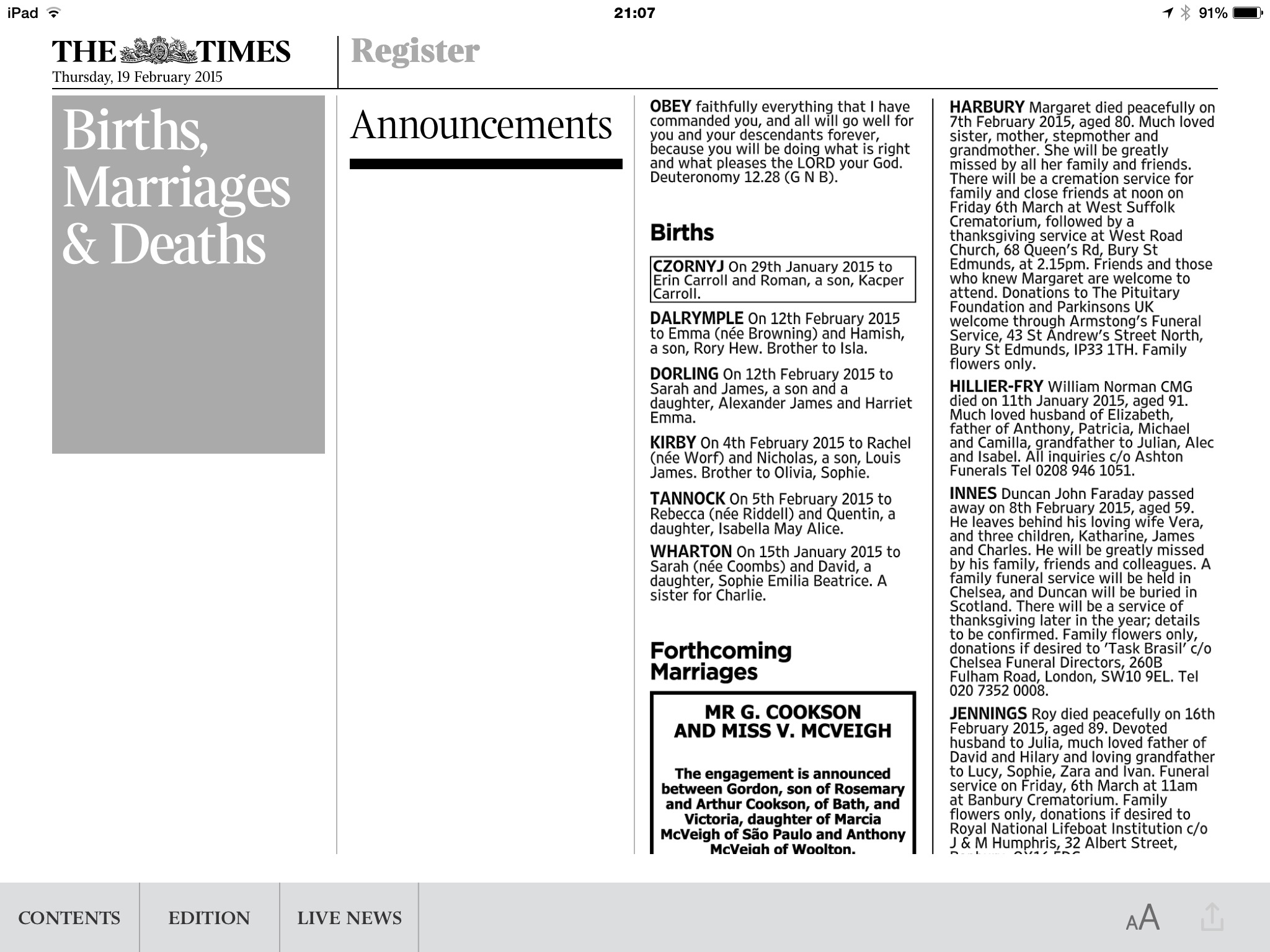
Susan Salant Burdick Sir Jeremy Lever KC Marie Salant Neuberger Obituary – Susan Salant Burdick Published in the Arizona Daily Star on November 20, 2011 Susan Salant Burdick age 67, died at home November 12, 2011 after a ten year battle with cancer. She was born in Arlington, VA and raised in Rye, NY and Tucson, AZ. She graduated from the University of Arizona with a bachelor’s degree and Case Western Reserve University with a master’s degree in social work. She was predeceased by her father, Richard Salant and her mother, Rosalind Livermore. She is survived by her husband, Michael Burdick; her two children, Dr. Julia Burdick (Nathan Faulkner) and Polly Henry (Phil); her siblings, Linda Breck, Robb Salant (Tanis), Priscilla Salant and Sarah Gleason (Jim) and nine grandchildren. Susan loved travel and the outdoors. She retired with her husband to Tucson because of her love of the desert. In Tucson she devoted herself to many worthy causes: Sabino Canyon Volunteer Naturalists, Pima County Foster Care Review board, Literacy Volunteers of Tucson and Pima Council on Aging. An avid hiker and cyclist, she and her husband traveled the US and overseas to enjoy the outdoors. Her favorite pastime was to bicycle with friends and enjoy coffee and conversation afterwards. She will be remembered for her candor, strong opinions, the friendships she cultivated and the wonderful daughters she raised. A celebration of her life will be held at Tanque Verde Ranch at 2:00 p.m., Thursday, December 1, 2011. Obituary – Rachel Brody Frank Tribute to Marie (Miriam, Micky) Elks Gilbert Although only one of us is able to stand in front of you this tribute is a joint expression of feeling which Anthony and I have worked on together. Mum latterly was a sad figure but we want you to remember her in her heyday as a hostess – a role in which she excelled. I want you to picture her at one of her afternoon teas in the dining room at Edgware with the best tablecloth on, the best china out and a ring of animated faces round the table, It seems to us that this exemplified all that was best in her, great sociability and gifted small talk. All agree she was a rare conversationalist, In fact many years ago one of her friends asked her to teach her how to do it. And she was a wit. She didn’t waste her puns. Hers were not the groaning variety, but ones we remember many years afterwards, Anthony particularly wanted to mention the rapport she had with his friends who got on with her like her house on fire. She had a flare for cookery and interior decoration, Within the family she was considered an arbiter of good taste. And she was a good friend. I think especially of her care and support for Evelyn Gabe and Stella Solomon in their latter years and her taking on the mantle of carer for Evelyn Fogel from my grandmother when it became too much for her. She was much loved. A number of family members have said she was a favourite aunt or cousin and we know she was a much loved sister of Judy. She was appreciated by the staff at Sunridge too, although she was sometimes described as”mouthy” – a flashback to her old days. One of them amused me by calling her Lady Gilbert and her carer Margaret to whom we owe an immense debt of gratitude called her Mrs Miriam, not Micky, out of respect for her age. So please remember Micky as she was meant to be. And as we say goodbye remember her with love. Obituary – Barnett Haysack (born Barnett Isaacs) Obituary – Margaret Harbury Obituary – Colin Harbury Obituary – Helen (Casey) Isaacs Herrick HERRICK-Helen (Casey) Isaacs, 87, daughter of Stanley Myron Isaacs and Edith Somborn, and wife of Snowden Terhune Herrick. Descendant of Myron Samuel Isaacs, founding Rabbi of Temple Sha’aray Tefila. Stanley M. Isaacs was former Borough President of Manhattan. Edith Somborn was the author of his biography ”Love Affair with a City”. Husband Snowden T. Herrick was former Deputy Director of Public Relations for the United Nations Center for Social and Economic Information (CESI). Mrs. Herrick founded and was Editor and Publisher of ”The Weekly Tribune,” the only English language newspaper in Switzerland, was a civil rights advocate and patron of theater and the arts. She was the co-founder and director of Population Communications International, and served on the Board of the Stanley M. Isaacs Neighborhood Center. Mrs. Herrick is survived by: son, Michael M. Herrick, Executive Chef, Royal Amsterdam Hotel, Pella, Iowa; granddaughter, Sanne Herrick; surrogate daughter Ava Stern, Managing Director, BSMG Worldwide in NYC; nephews John Isaacs, President, Council for a Livable World, Washington, D.C., and Stanley Isaacs, Palo Alto, California; and niece Jane Isaacs Toussaint, Cambridge, Massachusetts [sic – should have included Leni Isaacs Boorstin]. Service to be held at Temple Sha’aray Tefila Sunday, December 17, reception to follow at the Stanley M. Isaacs Neighborhood Center. Further details, phone 917-856-3486. Obituary – Snowden Terhune Herrick HERRICK – Snowden Terhune. Born 4th of March, 1919. Son of H.T. and Elinore Morehouse Herrick. Deceased 18 February, 1998 of leukemia. Is survived by his wife Casey Isaacs Herrick. Daughter of Stanley M. Isaacs, former Borough President of Manhattan. And his son Michael Morehouse Herrick of the Netherlands. Was Deputy Director of the United Nations Center for Economic and Social Information (1969-1979). Chief of Public Information Branch of the International Labor Organization (ILO) 1954-1967 while stationed in Geneva, Switzerland. He was also known as a civil rights activist; during W.W. II U.S. Air Force Captain Public Information Officer. A graduate of Yale University class of ’40. No service held. Visitors welcome after 5 P.M. at 345 East 73 St, New York City. No flowers please. Contributions can be made to The Stanley M. Isaacs Neighborhood Center. HERRICK-Snowden T. The Board of Directors and Staff of The Isaacs Center are saddened by the passing of Snowden T. Herrick, husband of founding Board Member, Casey Isaacs Herrick, and daughter of Stanley Isaacs. We will all greatly miss Snow and wish to extend our deepest sympathy to his wife, Casey, her son, Mike, and the Herrick & Isaacs families. Doris C. Halaby, Chairman Barry J. Alperin, President Wanda Wooten, Exec. Director Obituary – David Myer Isaacs “David Myer Isaacs.” The Jewish Messinger. May 16, 1879. Obituary – Helen S. Isaacs ISAACS-Helen Salant. Born and raised in Manhattan and a resident of White Plains since 1957, died on June 13th in her home, at the age of 89. She was married to the late Myron S. Isaacs and is the mother of Stanley Isaacs of Palo Alto, CA; Jane I. Toussaint of Cambridge, MA; John Isaacs of Washington DC; and Leni I. Boorstin of Los Angeles. She is also survived by nine grandchildren and one great grandchild. A service will be held on Monday, June 17th at 11AM in the Chapel in the Woods at Congregation Kol Ami, 252 Soundview Ave. in White Plains. Contributions in Ms. Isaacs’ memory may be made to the Stanley M. Isaacs Neighborhood Center, 415 E. 93rd St., NY NY 10128. Obituary – Kathleen Mary Lodge Isaacs http://www.expressandstar.com/news/2013/07/31/battle-of-britain-radar-operator-kath-dies-at-99/ Battle of Britain radar operator Kath dies at 99 A Battle of Britain radar operator who lived in Wolverhampton has died at the age of 99. Kath Isaacs answered an advert in a newspaper in 1939 calling for ‘young women of good breeding and intelligence’ to apply to the Air Ministry for a secret project. Leaving behind her job at department store Harrods, London-born Mrs Isaacs went on to train in the secret science of radar, which played an invaluable role in the Battle of Britain in 1940. Family tributes have today been paid to the mother-of-two, who died on Saturday. Born in Battersea just before the outbreak of the First World War, Kathleen Mary Isaacs left school at 15 to work in a mail order business before becoming a temporary worker at Harrods one Christmas. She went on to work in the children’s clothing department for a decade, even dressing royal offspring. But in late 1939, she spotted an advert in The Times for a secret project with the Air Ministry and was one of 3,000 people to apply. Mrs Isaacs was among a handful selected, despite cheating slightly by taking her glasses off before the interview. The medical officer in charge subsequently pronounced her fit, on the basis of ‘her cheek’. Mrs Isaacs reported the following morning for duty in the WAAF and, ordered to tell no-one, was whisked away to Bawdsley Island, off the coast of Suffolk, to train for nine months in the science of the early warning system radar, tracking German warplanes and giving the RAF sufficient time to attack them. She graduated in June 1940 and was posted to Dover shortly before the Battle of Britain. In a short film clip about her wartime experience, posted on YouTube, Mrs Isaacs recalled being on duty as German bombs were dropped on Dover. “I was on duty the night the first bombs were dropped on Dover and on our station,” she said. “We were so busy you didn’t realise that we were in any danger. “We were just so busy passing on information to our headquarters.” She described being on a cliff in a small wooden hut, tracking incoming ‘hostiles’ and reporting it to Fighter Command HQ. She also told how they were ordered to ‘keep mum’ about the radar stations, despite probing questions from soldiers who they met at dances at Dover Castle. “You had to keep absolutely mum about it,” she said. “Nobody could make out what these enormous masts were for. “The Germans knew about them, of course.” She also recalled one night during the height of battle, as bombs dropped on Dover. “I remember we were passing through the information to Flight Command headquarters and we were reporting hostiles –if you didn’t recognise them as your own, they were hostiles – and then the bombs dropped,” she said. “The CO came on ‘Dover, Dover, are you all right Dover? Are you all right Dover? God be with you Dover’. They couldn’t do anything about it.” Mrs Isaacs later trained other people in radar at RAF Cranwell in Lincolnshire. In the early 1940s, she married Terence, who served in the RAF. After the war, the pair moved to Wales, where Mrs Isaacs concentrated on bringing up the couple’s two sons John and Edward. After her husband’s death in 1970, she moved to Sussex, then to the North East and, at the age of around 86, to Tettenhall to be closer to Edward. Last year she moved from her home in Tettenhall to The Croft residential home in Finchfield where she was cared for until her death from natural causes. Her son John, who now lives in New York, today described his mother as ‘feisty’ and opinionated. “She had a certain cuteness and a certain charm which made people warm to her,” he said. Edward, of Stockwell End, Wolverhampton, who runs a housing consultancy firm, said: “Both my mother and my father told us about what they did during the war when my brother and I were growing up. “We were always so impressed with it,” he added. Mrs Isaacs was also a keen bridge player, enjoyed completing Daily Telegraph crossword puzzles and, while living in Wales, was the president of the local Women’s Institute. She also leaves behind granddaughters Hannah Isaacs of Birmingham, Naomi Isaacs of London and Antonia Bailey, of New York. A funeral service for Mrs Isaacs will be held on August 15 at 1.30pm at the West Chapel of Bushbury Crematorium. Obituary – Lewis M. Isaacs, Jr. ISAACS-Lewis M., Jr. Died April 26, 1997, 89 years old. Leaves loved daughter, Carol. His loving soul is more immortal than the stars and this will shine in our hearts forever. Donations can be made in his name to Stanley M. Isaacs, Neighborhood Houses, 415 East 93rd Street, NYC 10128 Obituary – Myron S. Isaacs “Myron S. Isaacs, Civil and Human Rights Advocate, Dies.” Gannett Westchester Obituaries. September 15, 1988. Obituary – Samuel Myer Isaacs Tributes to Samuel Myer Isaacs. 1878. Obituary – Sir Jeremy Lever KC Sir Jeremy Lever KC obituary: The Times, Saturday September 20, 2025, 12.01am BST, Sir Jeremy Lever believed in the hands-on discovery of facts Vanni Treves, the ever-charming chairman of Equitable Life, had been Lever was widely regarded as a father figure in British competition In the courts he went into battle on behalf of the Ford motor During that case he was based in IBM’s Paris headquarters, but was Back in Britain he represented Chanel when the Monopolies and He believed in the hands-on discovery of facts. When representing Given Lever’s closeness to European law, he was well placed to pick However, back in 2013 he foresaw that seceding from the EU would Jeremy Frederick Lever was born in London in 1933 the elder of two At 14 Lever entered a philatelic competition with an entry based on A place at Lancing College was withdrawn because of antisemitism He read PPE at University College, Oxford, before switching to law That same year he was called to the Bar and elected a fellow of All In 1961 Lever joined what became Monckton Chambers, which since As head of chambers, he went round the building on Friday evenings Another recalled writing a memo on some economic point and Lever On one occasion he represented Unilever in a case concerning Lever’s book, The Law of Restrictive Practices and Resale Price His work remained varied and in the mid-1980s he successfully In 2006 Lever, an expert in ceramics and a collector of English The intricacies of European law remained foremost in his mind. One of Lever’s many appointments was as chairman of the Sir Jeremy Lever KC, KCMG, competition lawyer, was born on June 23, Obituary – Marie Salant Neuberger PDF – “Marie Neuberger, 88, Philanthropist Devoted to Art and Education.” New York Times Obituaries. May 13, 1997. NEUBERGER-Marie Salant, 88, died on May 11th, 1997. Beloved wife of Roy R. Neuberger for nearly sixty-five years. Devoted mother of Ann Aceves, Roy S. and Linda Neuberger, and James Neuberger. Treasured grandmother of Andrea, Patricia and Matthew London, Sarah Lancry, Yaffa Jungreis and Miriam, Aharon and Nechama Neuberger, great-grandmother of seven. Cherished sister of Walter and Edna Salant and the late William Salant and his widow, Dorothy. Mrs. Neuberger was a past president of the Women’s City Club of New York, former chairman of the Board of Governors of The Ethical Culture Schools for thirteen years and a member of the Board of Trustees of Bryn Mawr College, her alma mater. In lieu of flowers, a contribution to any of the above organizations would be appreciated. Graveside services were held at Mount Neboh Cemetery, Queens, on Monday, May 12. A memorial service will be announced. NEUBERGER-Marie Salant. The Board of Trustees and the entire Ethical Culture Fieldson Schools community note with great sadness the death of Marie Salant Neuberger, Fieldston Class of 1926 and parent of three graduates. Marie will be remembered for her wisdom, integrity, and loyal commitment to the founding mission of the schools. Over the years she was a forceful, energetic advocate who served the schools in many capacities, including: Chair of the Board of Governors, Co-Chair of the Tate Library Committee, and Honorary member of the Board of Trustees. We extend our condolences to her husband, Roy, her children Ann, Roy, and James, and her brother Walter S. Salant. Sara E. Nathan and S. Donald Sussman Co-Chairs, Board of Trustees Jeanne E. Amster, Director NEUBERGER-Marie S. Purchase College and the Trustees of the Purchase College Foundation express their deep sense of loss on the passing of their friend and benefactress, Marie S. Neuberger whose commitment to education and to the Arts are paralleled only by her beloved husband Roy R. Neuberger. Marie Neuberger always will be remembered for her graciousness, intelligence, independence, warmth and extraordinary generosity. We offer our profound sympathy and heartfelt condolences to our dearest friend Roy R. Neuberger and sons Roy S. Neuberger and James Neuberger and daughter Ann Aceves. Bill Lacy, Pres. Purchase College. Emily Grant, Chair, Purchase College Foundation NEUBERGER-Marie Salant. The Women’s City Club of New York extends its profound sympathy on the death of Marie Neuberger to the Newberger family and indeed to all New Yorkers. Marie held many positions at the WCC, including the presidency, and was the only honorary president in our 82 year history. Her common sense, energy and refusals to accept the superficial have endeared her to the many organizations she participated in. Her passing is a loss to all of us. Peg Myerson, President NEUBERGER-Marie S. HINENI mourns the passing of Marie S. Neuberger, a woman of great integrity and impeccable ethics, whose love and concern for family touched the greater family of mankind. Our profound sympathy to her husband Roy Neuberger, Sr., her daughter Anne, her sons Roy and James Neuberger, and her many beautiful grandchildren and great-grandchildren. Rebbetzin Esther Jungreis, Pres. Barbara Janov, Executive Dir. NEUBERGER-Marie S. Purchase College Council gives it warmest sympathy to Roy R. Neuberger on the death of his beloved wife Marie. The Neuberger’s were a team of strong supporters of Purchase College for many years and Marie always joined with her husband in the substantial gifts made to the College over a period of many years. We will miss her. Richard Maass, Chair, Purchase College Council NEUBERGER-Marie Salant, 88, died on May 11th, 1997. Beloved wife of Roy R. Neuberger for nearly sixty-five years. Devoted mother of Ann Aceves, Roy S. and Linda Neuberger, and James Neuberger. Treasured grandmother of Andrea, Patricia and Matthew London, Sarah Lancry, Yaffa Jungreis and Miriam, Aharon and Nechama Neuberger, great-grandmother of seven. Cherished sister of Walter and Edna Salant and the late William Salant and his widow, Dorothy. Mrs. Neuberger was a past president of the Women’s City Club of New York, former chairman of the Board of Governors of The Ethical Culture Schools for thirteen years and a member of the Board of Trustees of Bryn Mawr College, her alma mater. In lieu of flowers, a contribution to any of the above organizations would be appreciated. Graveside services were held at Mount Neboh Cemetery, Queens, on Monday, May 12. A memorial service will be announced. NEUBERGER-Marie S. The Board of the Friends of the Neuberger Museum of Art deeply mourn the passing of Marie Salant Neuberger and extend our profound sympathy and condolences to founding benefactor and dear friend, Roy R. Neuberger, daughter Ann Aceves, sons Roy S. Neuberger and fellow Board Member James Neuberger & the entire Neuberger/Salant families. Her gracious manner and gentle nature belied a wealth of wisdom, strength of character and deep commitment to family values which she shared with the community through her abiding concern for public education and interest in the preservation and enhancement of the arts. We share the family’s loss. Lucinda Gedeon, Director Neubeger Museum of Art Mary Beth Buck, Chair Friends of the Neuberger Museum NEUBERGER-Marie Salant. The officers, leadership, and staff of UJA-Federation of New York mourn the passing of Marie Salant Neuberger. She, with her husband, Roy R. Neuberger, and their family, have been longtime, devoted supporters of UJA-Federation. She improved many lives through her great generosity and active community involvement, which included serving on the board of trustees of one of our member agencies, the Mosholu-Montefiore Community Center. We extend our deepest sympathies to her husband, Roy; her children, Ann Aceves, Roy and Linda, and James; her brother, Walter Salant; her grandchildren; her greatgrandchildren; and the entire family. Larry A. Silverstein, Board Chair Louise B. Greilsheimer, President Stephen D. Solender, Exec. V.P. NEUBERGER-Marie. The New York Society for Ethical Culture records with deepest sorrow the death of our devoted member on May 11, 1997. Mrs. Neuberger, a woman of remarkable intellectual curiosity and dedicated service to worthy causes, joined the Society in 1949. Mrs. Neuberger was a graduate of the Ethical Culture Schools, Chair of the Board of Governors, a devoted volunteer in the Ethical Culture Schools, and a committed advocate for excellence in the public schools. We extend our sympathy to her husband, Roy, her children Ann, Roy, James and her grandchildren and great grandchildren. Don Johnson, Senior Leader Judith Wallach, President Trustees & Staff of the New York Society for Ethical Culture NEUBERGER-Marie. Our deepest sympathy to the Neuberger family upon the loss of Marie Neuberger, devoted wife, mother, grandmother and great-grandmother. With her kindness and generosity she was a mainstay of our student scholarship fund. All that she did was done with modesty, dignity and warmth. Her presence will sorely be missed. May the Almighty comfort the entire family among the mourners in Zion. Rabbi Jacob Jungreis, Director Yeshiva Ateres Yisroel of Canarsie NEUBERGER-Marie Salant. The Alumni Executive Board of the Ethical Culture Fieldston Schools mourns the death of Marie Salant Neuberger, Class of 1926. She set an example of leadership that spans many years and we will miss her. Our heartfelt condolences to her husband Roy R. Neuberger, to her brother Walter Salant, to her children Ann Aceves, Roy S. and Linda Neuberger and James Neuberger and to her grandchildren and great-grandchildren. Dorothy Merlo Prodani ’72 Chair Alumni Executive Board NEUBERGER-Marie Salant. The Women’s City Club of New York extends its profound sympathy on the death of Marie Neuberger to the Neuberger family and indeed to all New Yorkers. Marie held many positions at the WCC, including the presidency, and was the only honorary president in our 82 year history. Her common sense, energy and refusal to accept the superficial have endeared her to the many organizations she participated in. Her passing is a loss to all of us. Peg Myerson, President NEUBERGER – Marie. The Trustees and the staff of The American Federation of Arts mourn the passing of Marie Neuberger, philanthropist, educator and great art lover, and extend heartfelt condolences to her husband, Roy Neuberger, President Emeritus and long-time benefactor of the AFA. Roy and Marie have been an integral part of the AFA family for half a century, she will be much missed. Robert M. Meltzer, Chairman Jan P. Mayer, President Serena Rattazzi, Director Obituary – Roy Rothschild Neuberger Roy R. Neuberger, who drew on youthful passions for stock trading and art to build one of Wall Street’s most venerable partnerships and one of the country’s largest private collections of 20th-century masterpieces, died on Friday at his home at the Pierre Hotel in Manhattan. He was 107 and had lived in New York City for 101 years. His death was confirmed by a grandson, Matthew London. Mr. Neuberger had set out to study art, but ended up as a stockbroker, a life path once likened to Gauguin’s in reverse. As a founder of the investment firm Neuberger & Berman, he was one of the few people to experience three of Wall Street’s major market crises, in 1929, 1987 and 2008. Although his artistic ability left no lasting impact, his wealth did. Believing that collectors should acquire art being produced in their own time and then hold on to it, giving the public access but never selling, Mr. Neuberger accumulated hundreds of paintings and sculptures by Milton Avery, Jackson Pollock, Willem de Kooning and others, becoming one of America’s leading art patrons. Those works are now spread over more than 70 institutions in 24 states, many of them in the permanent collection of the Neuberger Museum of Art, which opened in 1974 on the Purchase College campus of the State University of New York. The money to buy the works came from his investments at Neuberger & Berman (now Neuberger Berman), the brokerage and investment firm he founded in 1939 with Robert B. Berman. The firm catered to wealthy individuals but also took on a less affluent clientele with the establishment, in 1950, of the Neuberger Guardian mutual fund, one of the first funds to be sold without the usual 8.5 percent upfront sales commission. His art collecting drew on the lessons he learned in the financial world. Each year he would buy more than he had bought the previous year, often purchasing large lots at a time. In 1948, for example, he bought 46 paintings by Milton Avery, whom Mr. Neuberger counted as a close friend. He eventually owned more than 100 Avery works. “My experience on Wall Street made it possible for me to be comfortable buying a lot of art at once,” he later wrote. “In my investment firm, when we like a security after careful analysis, we buy a modest quantity. Sometimes after the purchase, we will find that we like it very much. If a large quantity of the stock then becomes available, and we are still enthusiastic about its value and its future, we will buy in quantity quickly, even though the day before we had no such plan and no knowledge that the stock would be available.” “The same principle,” he added, “applied to my purchase of the Avery paintings.” Roy Rothschild Neuberger was born on July 21, 1903, in Bridgeport, Conn. His father, Louis, who was 52 when Roy was born, had come to the United States from Germany as a boy. His mother, the former Bertha Rothschild, was a native of Chicago, a lover of music (she played the piano) and a “nervous, troubled woman from a large, well-to-do Jewish family, not related to the famous Rothschilds,” Mr. Neuberger wrote in an autobiography, “So Far, So Good: The First 94 Years” (John Wiley & Sons, 1997). His father was half owner of the Connecticut Web and Buckle Company and had an interest in the stock market, owning thousands of shares in a Montana copper company. The Neuberger family moved to Manhattan in 1909, settling on Claremont Avenue opposite Barnard College on the Upper West Side. Mr. Neuberger attended DeWitt Clinton High School, where in his senior year he was captain of the tennis team that won the Greater New York championship. “Looking back on my youthful addiction to tennis, I find it not much different from my fascination with the market,” Mr. Neuberger wrote in his autobiography. “You have to make fast decisions. You can’t wait to think about it overnight.” A similar impatience led him to leave New York University after a single year. He felt, he wrote, “that I could learn much more out in the world of business.” It was while working for two years as a buyer of upholstery fabrics for the department store B. Altman & Company that he said he developed an eye for painting and sculpture as well as a sense for trading. Both would greatly influence his later life, as would John Galsworthy’s series of novels “The Forsyte Saga,” which described the practice among well-to-do English families of educating their children on the European continent, and “Vincent van Gogh,” a biography by Floret Fels. The first book led Mr. Neuberger to a sojourn in Europe. Using money inherited from his father, he set out in June 1924 for a life of leisure. While living mainly on the Left Bank in Paris, he spent afternoons at a cafe, played in tennis tournaments in Cannes and traveled to Berlin and other European capitals. In Paris, Mr. Neuberger was inspired by the van Gogh biography to collect and support the work of living artists. “Of course, to do so, I had to have capital of considerably more than the inheritance that gave me an annual income of about $2,000,” he later wrote. “In those days you could live very comfortably, almost luxuriously, on $2,000, but you couldn’t buy art in quantity. So I decided to go back to work in earnest.” He arrived on Wall Street in the spring of 1929, as the bull market was roaring toward its peak. Hired for $15 a week as a runner for the brokerage firm Halle & Stieglitz, he soon learned all aspects of the business, at the same time managing his own money. One of the first big trades he executed on his own behalf was designed to hedge his own wealth against the possibility that the stock market might fall from its precarious height. He sold short 100 shares of the Radio Corporation of America, the most popular stock of the era, betting that its price would decline from its lofty level of $500. In October 1929 came the crash that ushered in the Great Depression, and while Mr. Neuberger’s blue-chip stocks fell, his bet against RCA paid off well: the stock’s price eventually fell into the single digits. He said he lost only 15 percent of his money in the crash, while many others lost everything. On June 29, 1932, the Dow Jones industrial average dipped to 42 and Mr. Neuberger married Marie Salant, a graduate in economics from Bryn Mawr who had gone to work in the research department of Halle & Stieglitz two years earlier. “I can report that by June 29, 1996, the Dow Jones industrial average had climbed to 5,704 and Marie and I had had 64 wonderful years together,” Mr. Neuberger later wrote. Mrs. Neuberger died in 1997. Besides Mr. London, Mr. Neuberger is survived by his daughter, Ann Neuberger Aceves; his sons, Roy S. Neuberger of Lawrence, N.Y., and James A. Neuberger of New York City; seven other grandchildren; and 30 great-grandchildren. Emboldened by his management of his own assets, Mr. Neuberger became a stockbroker at Halle & Stieglitz in 1930, leaving nine years later to start his own firm, Neuberger & Berman. The firm was later acquired by Lehman Brothers, but spun off in 2008 as a stand-alone company with Lehman’s bankruptcy. Mr. Neuberger continued to go to his Neuberger Berman office every day until he was 99, Mr. London said. Mr. Neuberger began to build his art collection in the late 1930s, and although he was asked to do so many times, he never sold a painting by a living artist. “I have not collected art as an investor would,” he said. “I collect art because I love it.” He preferred to share his love by donating works to museums and colleges. In May 1965, Mr. Neuberger received an anonymous offer to buy his art collection for $5 million, a sum he considered a fortune at the time. Years later he learned that the offer had come from Nelson A. Rockefeller, then governor of New York. Mr. Rockefeller went on to play a key role in Mr. Neuberger’s art collection. In May 1967, while Mr. Neuberger was visiting Mr. Rockefeller at his Pocantico Hills estate in Westchester County, the governor offered to have New York State build a museum to house the collection at the State University campus at Purchase. Designed by Philip Johnson, the museum opened in May 1974. Mr. Neuberger often said that the true spirit of his collection could be found on the second floor, which held seminal paintings by Pollock, Stuart Davis, Edward Hopper and Georgia O’Keeffe, as well as many Milton Averys. Mr. Neuberger made an additional gift of $1.3 million to the State University at Purchase in 1984 and other major gifts to the Museum of Modern Art and the Metropolitan Museum of Art. He also served as a president of the New York Society for Ethical Culture and the American Federation of Arts. Mr. Neuberger’s second memoir, “The Passionate Collector,” was published by John Wiley & Sons in 2003. At a White House ceremony in 2007, President Bush presented Mr. Neuberger with a National Medal of Arts. Like any collector, Mr. Neuberger rued the ones that got away. He remembered passing up a Grant Wood painting as well as refusing to pay $300 for a Jasper Johns in the late 1950s. One time a dealer offered him a Picasso sculpture for $1,500, but he declined because he was buying works only by American artists. “I was such a square that I stupidly didn’t buy it,” he told The New York Times in an interview in 2003. Mr. Neuberger bought all his works himself, usually through dealers. And his taste ran toward the bold. “I liked adventuresome work that I often didn’t understand,” he told The Times as he was celebrating his 100th birthday. “For art to be very good it has to be over your head.” But he said he enjoyed the challenge that the work posed to the viewer. “Those who understand the mysteries of art,” he said, “are made happier by doing so.” A Tribute to Art Collector Roy R. Neuberger (1903-2010) http://arthistory.about.com/od/help_advice_for_students/a/A-Tribute-to-Art-Collector-Roy-R-Neuberger.htm Life: The American art collector Roy Rothschild Neuberger died on Christmas Eve 2010 in the Pierre Hotel, his New York residence. He was 107. Almost a mirror-image of the French painter Paul Gauguin, he briefly studied art in Paris in the late 1920s, then gave up in favor of amassing a fortune as a stockbroker in order to pursue his passion for collecting art. (Gauguin was a stockbroker first, then a collector and finally a full-time artist.) Neuberger’s autobiography, So Far, So Good – The First 94 Years (1997) begins with “When I was born, Teddy Roosevelt was president, the Wright brothers were preparing for their epic flight and the first automobile trip across the United States (from San Francisco to New York) was underway.” Direct and plain-spoken, So Far, So Good outlines the key ingredients for financial and personal success: hard work, open-minded research, focus, drive, connections and aiming for the top without losing sight of those who helped in the process. Neuberger came from an affluent family. He was the youngest of three children and orphaned at 12 years old. His sister Ruth (12 years his senior) became his guardian. She married in 1919 and her husband Aaron Potter, a businessman, became an influential father figure. After boarding school, public school and one semester at New York University, Neuberger parlayed himself into his first job at the major department store B. Altman and Company by making an appointment with a fellow former Bridgeport resident, Milton Klein, who was the vice president. It was 1922 and Neuberger was only 19.The future financial wizard literally started in the basement, in the Receiving Department, and soon impressed the head of interior decorating when an imported shipment needed special attention. This encounter landed Neuberger a position in the interior decorating department where he ended up as the upholstery buyer the next year. Savvy Altman colleagues provided cultural mentoring.They took Neuberger to art galleries, the theater and the opera. He also received training in practical business management, including innovative customer relations and merchandising ideas. The experience served him well when he moved into the financial world later on. The department store magnate Benjamin Altman (1840-1913) and his business partner Michael Friedsam (1858-1931) were avid art collectors and important donors to the Metropolitan Museum of Art during the first half of the twentieth century. Neuberger would become a powerful patron of the arts during the second half of the twentieth century, and was given an “Honorary Trustee” position with the Met in 1968. During his 1924 vacation from Altman’s, Neuberger took his first trip to Paris. In 1925 he returned to the City of Lights and stayed for the next four years. He read, studied art at the Louvre and befriended numerous writers, artists and art historians (such as Columbia’s Meyer Schapiro). Then he discovered Florent Fels’ new biography of Vincent van Gogh, which “changed” his life. Deeply moved by this tragic story of an under-appreciated genius, Neuberger decided that supporting emerging artists would be his calling. He left Paris determined to amass a fortune on Wall Street (“where the money is”) and collect art. Neuberger’s family connections got him into Jerome Dantzig’s office at Bear Stearns in 1929, just before the crash. Dantzig recommended Neuberger to the brokerage firm Halle and Stieglitz. The young stockbroker honed his skills for ten years and then created his own asset management firm Neuberger and Berman with fellow H and S broker Robert Bennett Berman. Neuberger and Berman was sold to Lehman Brothers in 2003 (after Neuberger’s 100th birthday) and then survived the 2008 collapse of Lehman by being sold back to the management firm. Roy R. Neuberger’s legacy remains firmly entrenched in the art world through his collection, generous donations and the Neuberger Museum of Art located on the campus of the State University of New York at Purchase (a.k.a. Purchase College). “The Neuberger” (or NMA) was the brainchild of Neuberger’s close friend Nelson Rockefeller, a fellow Westchester County resident and passionate collector of contemporary art, as well as the governor of New York from 1959 to 1973. Neuberger donated 850 pieces. Today the museum owns over 6,000 works of art. The museum’s permanent collection features the Abstraction Expressionist and Color Field paintings Neuberger acquired: Pollock, de Kooning, Rothko and more. A fall 2010 sale at Sotheby’s showcased Neuberger’s taste in the 1990s, when he prospected for young talent then. Purchase College will miss Roy R. Neuberger and will be forever grateful to his family for keeping his spirit alive through the museum, its programs and its contribution to the community. So far, so good, Mr. Neuberger. Thank you. Date and Place of Death: December 24, 2010, New York Citybr> (His wife of 64 years, Marie Salant Neuberger, died on May 11, 1997). Obituary – Aaron Salant Obituary – Gabriel Salant Obituary – Richard S. Salant “Richard S. Salant Dies: Former Head of CBS News.” Washington Post Obituaries. February 17, 1993. Obituary – Louis Salant Obituary – Walter S. Salant Walter S. Salant, who as a graduate student in the 1930’s and later as a Government and private economist helped infuse the revolutionary teachings of John Maynard Keynes into Washington policy deliberations, died on Friday at a hospice near his home in Washington. He was 87. After graduating from Harvard University in 1933, Mr. Salant attended the lectures of Keynes at Cambridge University, two years before he published ”The General Theory of Employment, Interest and Money” — the discipline-shattering treatise that argued that industrialized economies, then mired in depression, were unlikely to recover on their own but could use Government spending and tax cuts to do so. Mr. Salant returned to Harvard and joined the celebrated fiscal policy seminar run by Professors Alvin Hansen and John Williams that explored Keynes’s new ideas and trained economists who went on to build a discipline forged in part on the Keynesian foundation. ”It was an economically depressed time,” James Tobin, a Nobel laureate at Yale University, recalled in a recent interview. ”Most older professors other than Hansen himself had no explanation or understanding of what was happening, and no solution. The idea that Keynes had an explanation and a solution that involved an intellectual revolution but not a proletarian revolution was a pretty exciting thing. Walter was part of the core Keynesian group, a major figure of what became the center of American Keynesianism.” Mr. Tobin calls a short book, ”An Economic Program for American Democracy,” that Mr. Salant co-wrote with a number of graduate students in 1938 a ”Keynesian manifesto” — one of the first strong polemics in the United States on behalf of more Government investment and other Keynesian ideas that were then revolutionary but would, because of the efforts of Mr. Salant and others, become mainstream. Mr. Salant left Harvard for a series of Government positions. He served in the Treasury Department, the Securities and Exchange Commission and Commerce Department in the 1930’s, and, in the 1940’s, the Office of Price Administration and other agencies that designed the national strategy for wartime price controls. He was a senior staff member for international relations on the President’s Council of Economic Advisers from 1946 to 1952. He later served as a consultant to NATO and in the Treasury Department in the Kennedy and Johnson Administrations. He left the Government in 1954 to become a senior fellow at the Brookings Institution in Washington, staying until 1976. Mr. Tobin credits Mr. Salant with helping to ”internationalize Keynes.” ”The General Theory,” Mr. Tobin said, ”analyzed economies that engaged in no trade. Mr. Salant applied its lessons to a world that increasingly relied on trade and foreign investment — analyzing how trade surpluses play the same role in an economy to create employment and output as do private investment or Government spending.” Prof. Charles P. Kindleberger of M.I.T. points to an influential report that Mr. Salant prepared for the Truman Administration showing that the proposed Marshall Plan — a massive aid program for the reconstruction of Europe — was affordable, financially feasible and would not, as critics feared, ignite a ruinous inflation. Mr. Kindleberger also cites Mr. Salant’s contributions to analyzing America’s balance-of-trade deficits, a problem so severe that a senior official in the Kennedy Administration cited it along with nuclear arms as the two biggest issues confronting Government. A report that Mr. Salant wrote with Lorie Tarshis, Emile Despres, Alice Rivlin, now vice chairman of the Federal Reserve Board, and other distinguished economists at the request of President Kennedy’s Council of Economic Advisers laid out the proper economic role of the United States as the world’s central bank. Just as central banks need to provide currency to their domestic economies, they said, the United States needs to supply dollars to the international economy. In a controversial article he wrote in 1966 with Mr. Kindleberger and Mr. Despres, Mr. Salant explained that a steady outflow of dollars to pay for the trade deficit was no economic catastrophe. Indeed the outflow was necessary to feed an international economy desperate for liquidity. Ms. Rivlin says the staff of the Brookings Institution in the 1960’s included many distinguished economists who, like Mr. Salant, worked on practical problems of economic policy. His colleagues included Kermit Gordon, Joseph Pechman, Herb Stein, Charles Schultze and Arthur Okun, all of whom served in the Federal budget office or on the Council of Economic Advisers. She also cites Mr. Salant’s role as mentor. He was, she said, ”one of those people who took you under his wing.” Mr. Salant was born in New York City in 1911 and received his Ph.D. in economics from Harvard in 1962. He served on the Board of Editors of the American Economic Review, the journal of the American Economic Association, from 1956 to 1958. He is survived by his wife, Edna; two sons, Michael, of Washington, and Stephen, of Ann Arbor, Mich., and three grandchildren. Referring to his decision to leave university life for Washington in the Depression, Mr. Salant wrote in a reminiscence of the New Deal that he spirit of the Roosevelt Administration brought in young people like himself, ”generated ideas, fermentation, energy, a feeling that something was being done, that there was leadership when leadership was needed, that there was a relationship between the government and the people in which the government was the citizen’s friend.” Obituary – William Salant Obituary – Colin Harbury |
 |
-
Subscribe
Subscribed
Already have a WordPress.com account? Log in now.
 Isaacs-Salant Family